Is a community worth it for your Shopify store?
 Social Place · 5 min read
On this page
A community on your store sounds like a good idea. But is it worth the time, for a small brand that already juggles orders, Instagram and customer emails? The honest answer: it depends on your niche, on the time you can give it and on how patient you are. Here’s what a community really costs, what it brings, how to measure it and when it isn’t worth it.
What a community really costs
The subscription is the smallest part. The real costs are elsewhere:
| Cost | What it means | How to keep it low |
|---|---|---|
| Your time | Three posts a week, and a few minutes a day to react and reply | Reuse what you already make: Instagram posts, behind the scenes, customer questions |
| Patience | Months before customers post without being asked | Decide from the start to give it at least three months |
| Rewards | Discount codes for active members cost margin | Mix codes with rewards that cost almost nothing: badges, early access, a word of thanks |
| The tool | A monthly subscription for a forum app | Compare it with what you spend each month on ads or on a loyalty program |
Time is the cost that decides everything. A community that gets one post a month won’t bring much, whatever the tool.
What it brings, and how you’ll see it
A community rarely shows up as a single line in your sales report. It works through several smaller effects, each of which you can observe:
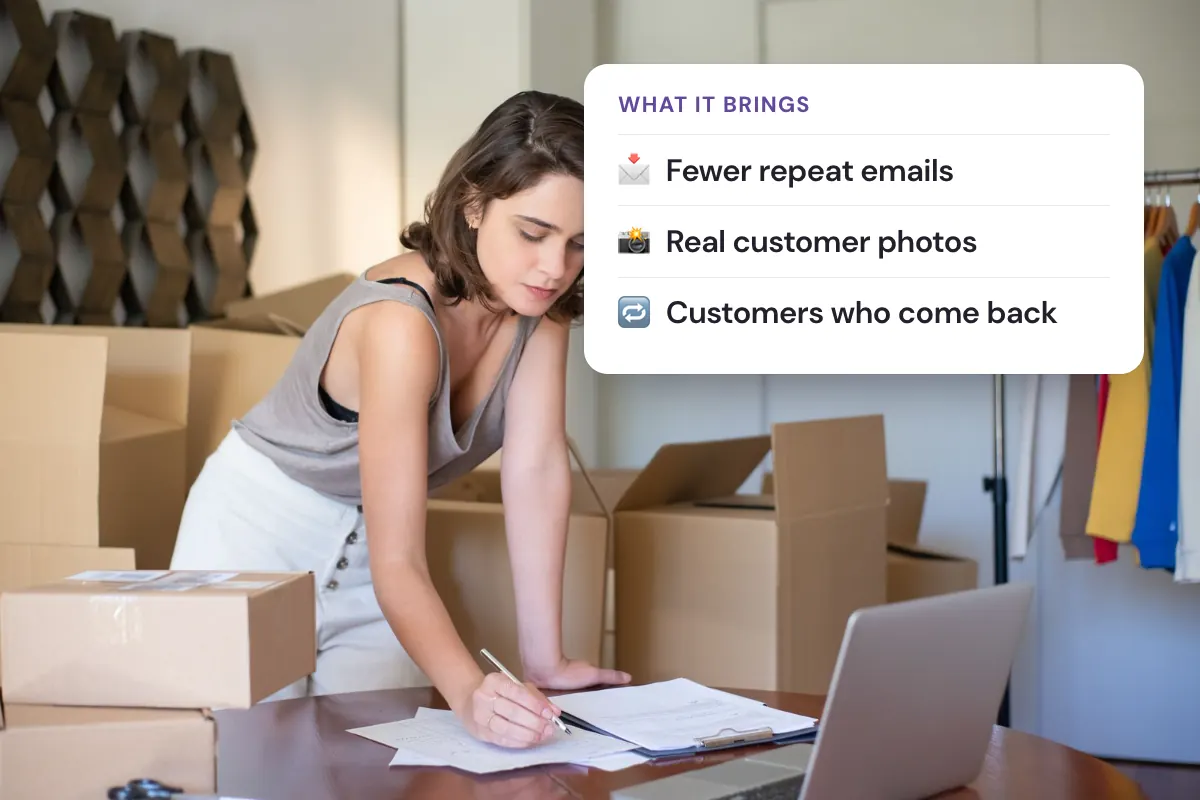
- Fewer repeat emails. A question answered once in public is read by everyone who wonders the same thing. Count your product questions by email before and after. See how to stop answering the same customer questions.
- Customers who come back between orders. Replies, new posts and rewards bring them back to your store, where your products are one click away.
- Real photos and reviews. Customer photos reassure the next shoppers better than studio shots. See how to get customers to share photos of your products.
- Feedback before you produce. A vote on two colors before a launch can save you from making the wrong one. See how to launch a new product with your community.
- Content in your customers’ words, on your own domain, which can bring visits from Google over time. See how customer content helps your Shopify store rank on Google.
- Ambassadors. The most active members end up recommending you around them. See how to turn your best customers into brand ambassadors.

- What it costsmostly your time
- What it bringsanswers, photos, visits, feedback
How to measure it
You don’t need a complicated dashboard. A few numbers, checked once a month, tell you whether the community is starting to work:
| What to watch | Where to find it | What it tells you |
|---|---|---|
| Active members | The forum’s analytics | How many people post, comment or react, not just read |
| Visitors who take part | The forum’s analytics | Whether reading turns into writing |
| Product questions by email | Your inbox | Whether public answers save your team time |
| Reward codes used | Your Shopify discounts | Whether members come back to order |
| Your most active members’ orders | Their customer page in Shopify | Whether your regulars in the forum are also your regular buyers |
With Social Place, the Analytics page shows views, new and active members, how visitors turn into contributors and the most shared posts, compared with the previous period. The Rewards page lists every discount code given, with how many times it was used.
Give it three months, then decide
The fairest way to know is to try it properly, for long enough. Here’s a three-month test:
Your storeMonth 1
Install the forum, make it visible, fill it with posts and photos
Do people visit it?
Your storeMonth 2
Three posts a week, a reaction on every reply, a first reward
Do members reply, and come back?
Your storeMonth 3
Link the forum in your emails, run a vote with a real stake
Do questions arrive there instead of your inbox?
After three months, you won’t have a big community yet. But you’ll know whether your customers want to talk, and that’s what decides the rest. If the forum stays quiet, check the usual causes first: see how to bring a quiet store community back to life.
When it isn’t worth it
A community isn’t for every store. Be honest with yourself if:
- Your product is bought once and forgotten, with no questions, no use to show and no life around it.
- You can’t give it any time, not even a few minutes a day. An abandoned forum does more harm than no forum.
- You expect sales next week. A community builds over months; for quick sales, a promotion or ads work faster.
Even then, a lighter version can pay off: a forum used for announcements and answers, where each customer question is answered once for everyone.
Compared with what you already pay for
- Ads bring visitors as long as you pay. A community keeps what you build: every answer, every photo, every member stays.
- A loyalty program rewards orders. A community also rewards what happens between orders. The two work well together: see how to reward customers with points, levels and badges.
- A Discord server or a Facebook group doesn’t charge you, but the conversations stay on someone else’s platform, away from your products. See Discord, Facebook group or a forum on your store?
Ready to try? Here’s how to add a forum to your Shopify store, then how to build an online community for your Shopify store for the first months.
FAQ
Is a community worth it for a small Shopify store?
It depends on your niche, your time and your patience. It works best when customers do something with your products, have questions and like to show the result, and when you can post a few times a week for several months.
What does a store community cost?
Mostly your time: three posts a week and a few minutes a day to react and reply. Add the app subscription and the discount codes you give as rewards.
How do I measure whether my community works?
Once a month, look at active members, the share of visitors who take part, the product questions you still get by email, the reward codes used and the orders of your most active members.
How long before a community pays off?
Count in months. Give it at least three months of regular posts before deciding, and expect it to keep growing after that.
When is a community not worth it?
When your product is bought once with no questions or life around it, when you can’t give it any time, or when you expect sales next week.